
Skip to content
Holt Systems

Auger filler upgrade for the filler you already own

Many auger fillers are mechanically sound but limited by basic controls. A servo and control retrofit gives them the accuracy and recipe handling of a far more expensive machine.

Request a site assessment
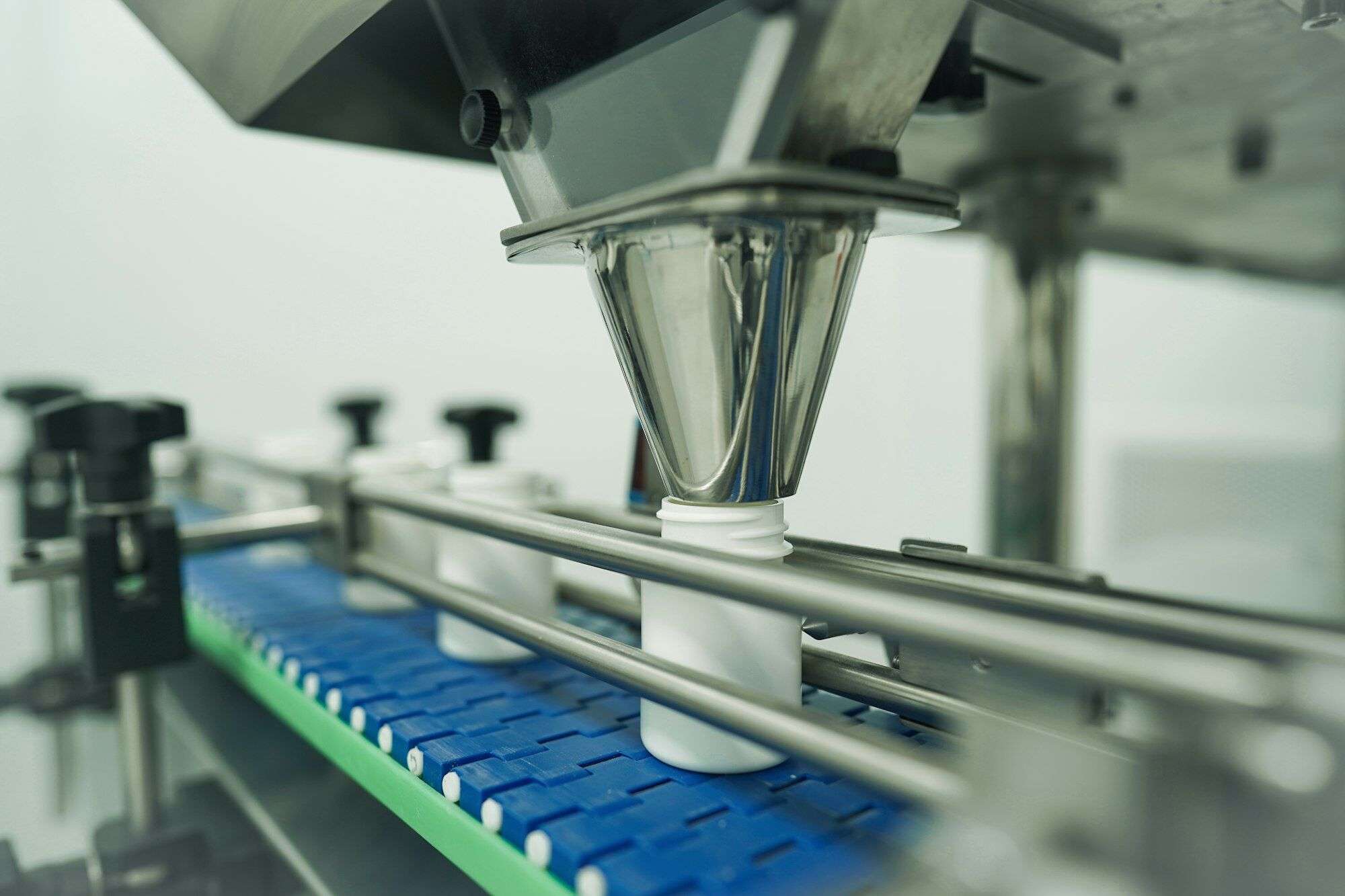
Stainless steel filling funnel of an auger filler dispensing into containers on a conveyor

An auger filler upgrade replaces the drive and controls on an existing filler while keeping its frame, hopper, agitator and tooling. Many supplement packers operate imported volumetric auger fillers that are mechanically sound but held back by basic controls: an induction motor with a clutch and brake, or a stepper motor on a simple controller with no way to correct the dose during production.

The limits of a basic auger filler

A basic volumetric filler doses by running the auger for a set number of turns or a set time. On these machines, the symptoms are well known to filling room staff:

  • Fill weights that vary from pack to pack, with a spread wide enough that the target has to be set well above declared weight
  • Weights that drift through the run as the powder settles or the hopper level changes
  • Manual adjustment of the auger setting after each check-weigh, which depends on the operator
  • No recipe storage, so each changeover requires the settings to be found again
  • Controller faults and spare parts that can only be sourced from the original overseas supplier

The machine itself is rarely the problem. The auger and tooling determine how consistently powder is delivered per revolution. The drive and controls determine how precisely those revolutions are delivered and whether they can be adjusted automatically.

Why the drive matters

On clutch-brake fillers, the auger stops when the brake engages, and the stopping point varies with brake wear and temperature. Stepper motors can lose steps under load, particularly with dense or sticky powders. In both cases, the number of auger revolutions per fill is not as consistent as the controller believes.

A servo motor is controlled in a closed position loop. It accelerates, runs and stops the auger at a precisely controlled position every fill, and reports its actual position back to the controller. The dose becomes a precise, adjustable number of revolutions, which is exactly what checkweigher feedback needs to correct for changes in powder density.

The auger filler upgrade scope

A typical retrofit includes:

  • A servo motor and drive coupled to the existing auger shaft, with a mounting adaptor where required
  • A new control panel with a programmable logic controller (PLC) and a touchscreen operator interface
  • Recipe storage for each product and pack size, including target weight, auger speed and adjustment limits
  • A communication link to the checkweigher, so every pack weight is used to trim the next fills
  • Interlocks with the container conveyor and the existing guarding
Auger filler upgrade with servo drive and checkweigher feedback Checkweigher Weighs each filled pack Controller Recipes, trends and dosecorrection Servo drive Turns the auger an exact number ofrevolutions Auger filler Existing hopper, auger and tooling Every filled pack is weighed
Auger filler upgrade with servo drive and checkweigher feedback

How it works

  1. 1

    Select the recipe

    The operator selects the product and pack size, which loads the target, auger profile and adjustment limits.

  2. 2

    Dose precisely

    The servo turns the auger the set number of revolutions with a controlled acceleration and stop, every fill.

  3. 3

    Weigh and correct

    Each pack weight returns from the checkweigher. The controller trims the dose in small steps to hold the average on target.

  4. 4

    Record

    Weights, adjustments and recipe changes are logged for quality records and troubleshooting.

The control strategy that holds the average on target is described in more detail on our page on protein powder filling accuracy.

The commercial case for a retrofit

A retrofit delivers two benefits. A tighter spread of fill weights allows the target to be lowered, reducing overfill on every pack. And a supported, documented control system removes the risk of a filler stopping because a proprietary controller has failed.

Retrofit or replace?

  • Keep the current controls. No outlay, but overfill continues and controller failures remain a risk.
  • Buy a new servo filler. A sound option where the existing machine is worn out. Where the mechanics are sound, a new machine costs considerably more than a retrofit and still needs integration with the checkweigher.
  • Net-weigh filling. Weighs every fill directly and is very accurate, but involves a larger investment and is often slower for fine powders.
  • The original supplier’s upgrade. Worth asking about. Some imported fillers have no upgrade path or local support, which is often what leads packers to consider a retrofit.

How a project runs

Every project follows the same five stages. For a filler retrofit, the work is planned around production runs so the line is out of service for as short a time as possible.

  1. 1

    Site assessment

    We inspect the filler's auger, tooling, agitator, drive and controls, review fill-weight data and confirm the checkweigher's communication options.

  2. 2

    Proposal

    A defined scope covering servo, controls and integration, a fixed price, a program planned around production and the projected accuracy and overfill benefit.

  3. 3

    Off-site build and test

    The new control panel, servo drive and program are built and tested off-site, including recipes for each product and pack size.

  4. 4

    Installation and commissioning

    The retrofit is installed during a planned production break. Fill accuracy is verified against the checkweigher before handover.

  5. 5

    Handover and support

    Operators are shown the new interface and recipes, and you receive drawings, program backups, recipe records and local support.

Why Holt Systems

A filler retrofit keeps the machine you have paid for and replaces only the part that limits it, which is the controls.

Electrical, instrumentation and controls work is carried out under QLD Electrical Contractor Licence 1513082. Installations are completed to AS/NZS 3000 (the Wiring Rules), machine safety functions are designed with reference to AS/NZS 4024, and PLC programs are written in IEC 61131-3 languages and fully documented.

Manufacturer independent
We work across Siemens, Allen-Bradley (Rockwell Automation), Schneider Electric and Omron, and specify hardware on technical merit and local support availability.
Scoped to the requirement
Work is scoped to the specific machine, line or plant area, without the overheads of a large integrator, and quoted at a fixed price.
Reduced shutdown duration
Off-site build and testing means shutdown time is spent on installation and commissioning rather than fault-finding.
Single point of accountability
One accountable lead from site assessment through design, installation and handover.

Auger filler upgrade questions

Which fillers can be retrofitted?

Most single-head auger fillers with a sound frame, hopper, agitator and tooling can be retrofitted, including many imported machines. Fillers with worn auger tooling or a damaged hopper may need mechanical repair first, which is identified at the site assessment.

Do we need a checkweigher?

A servo retrofit alone improves repeatability. Closing the loop with a checkweigher delivers the larger benefit, because it corrects the drift in powder density. If you do not have a checkweigher, one can be included in the scope.

How long is the filler out of service?

Because the panel and program are built and tested off-site, installation and commissioning typically fit within a planned production break of one to two days, depending on the machine.

Can the operators still adjust fill weights?

Yes. Operators select a recipe and target weight from the touchscreen. Adjustment limits and password levels prevent changes outside agreed ranges.

Will the retrofit affect food safety or cleaning?

The retrofit changes the drive and controls, not the product contact parts. Enclosures and cable entries are selected for the washdown and cleaning regime in your filling room.

What about spare parts and support?

Servo drives and controllers are specified on local support and spares availability, and the program and drawings are handed over in full, so the filler no longer depends on an overseas supplier.

Request a site assessment

Provide a brief outline of your site and requirements, and we will contact you to discuss the scope and arrange a site visit.

Or email hello@holtsystems.com.au

Your details are handled in accordance with our privacy policy.