
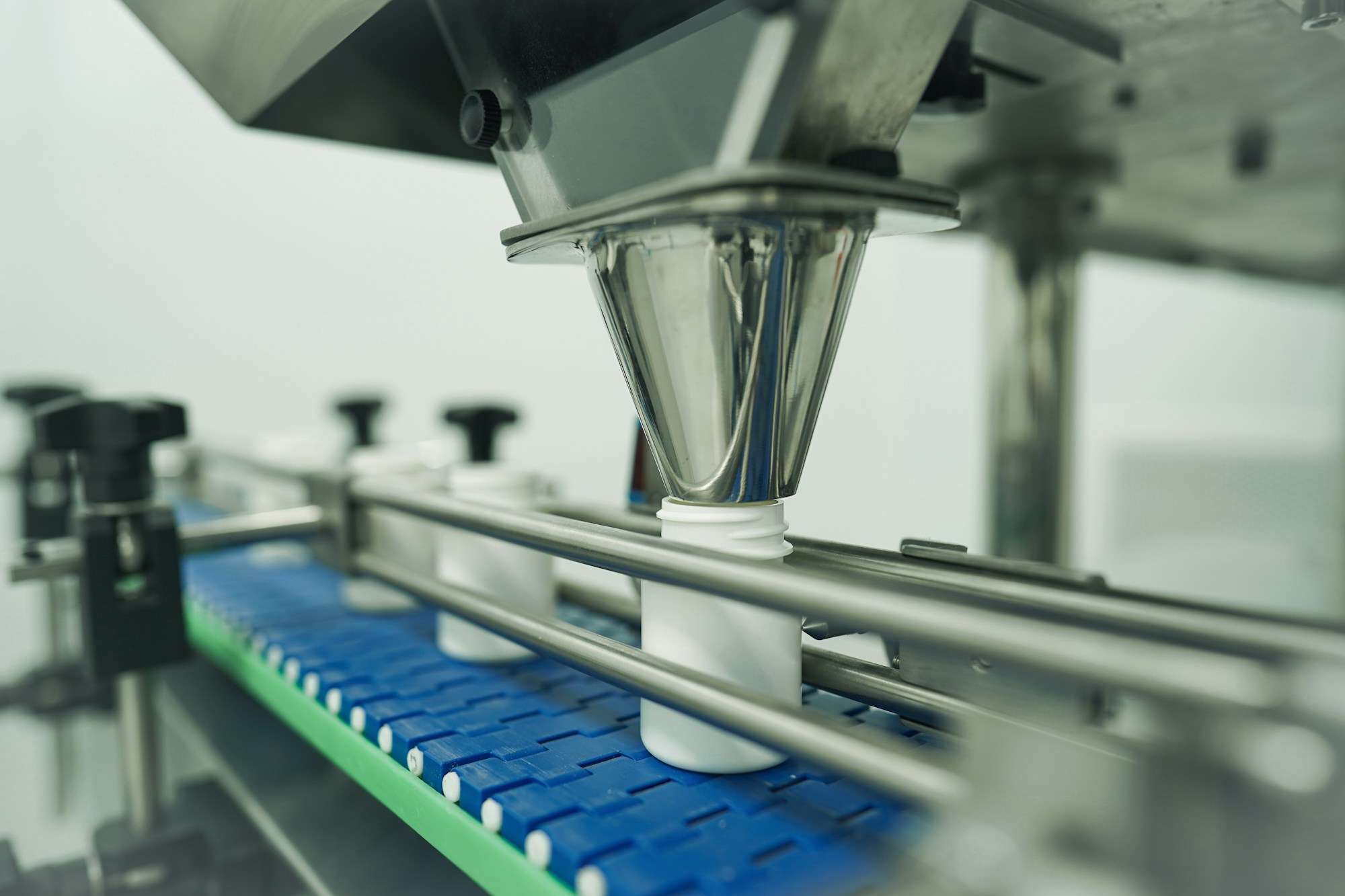
Protein powder filling accuracy determines how much product leaves the plant without being paid for. Most powder lines are deliberately set above declared weight so that underweight packs are avoided. With whey and plant protein powders among the higher-value products a food or supplement plant fills, each gram of that safety margin carries a real cost, repeated across every tub and pouch.
Where the overfill comes from
On a typical line, an auger filler doses each tub and a checkweigher downstream rejects packs that fall below a set weight. The two machines operate independently. The checkweigher identifies underweight packs but does not correct the filler that produced them.
As a result, fill weight is managed by operators. They check weights periodically and adjust the filler by hand, and the target is set high enough to absorb drift between those checks. The symptoms are familiar:
- Average fill weights several percent above declared weight, set as insurance rather than by measurement
- Fill weights that drift through a shift, then step when an operator intervenes
- Checkweigher rejects that rise when a new lot of powder or a new flavour is introduced
- Fill-weight performance that varies between shifts and between operators
Why auger fillers drift
An auger filler is a volumetric device. It doses a set volume of powder, by counting auger revolutions or by running the auger for a set time, and the delivered weight is that volume multiplied by the powder’s bulk density.
Protein powder bulk density is not constant. It changes with humidity and temperature, with the lot and the flavour system, and with how much air is entrained in the powder. It also changes with hopper level, because the weight of powder above the auger compresses the material being dosed. As density changes, the weight delivered by a fixed auger setting changes with it, even when the filler itself is in perfect mechanical condition.
Improving protein powder filling accuracy
The solution is to close the loop between the checkweigher and the filler. Every pack weight is passed to a controller, which tracks the running average and adjusts auger output in small increments to hold the average on target. Density drift is corrected as it develops, rather than after the next manual check.
How it works
- 1
Weigh
The checkweigher weighs every pack in-line and sends each weight to the controller over Ethernet or a serial link.
- 2
Analyse
The controller calculates a rolling average and the spread of recent fills, ignoring rejected and out-of-range packs.
- 3
Correct
When the average moves away from target, the controller adjusts the auger dose by a small, limited amount, without stopping the line.
- 4
Record
Pack weights and every adjustment are logged by product and batch, giving your quality team a complete fill-weight record.
Because drift is corrected continuously, the spread of fill weights narrows. A narrower spread allows the target to be set closer to declared weight with the same confidence of avoiding underweight packs. The reduction in overfill comes from that lower target, not from accepting more risk.
Trade measurement requirements
Packaged goods sold by weight in Australia are regulated under the National Measurement Act 1960 and the National Trade Measurement Regulations 2009, administered by the National Measurement Institute (NMI). Under the Average Quantity System, the average content of a sample from a production run must not be less than the declared quantity, and individual packs must not fall short by more than a tolerable deficiency. NMI tested 61,263 lines of pre-packaged goods in 2023 to 2024 and found 3.2% contained less product than stated. This is general information only; packers should refer to NMI guidance for their own obligations.
What reduced overfill is worth
The value depends on four figures: packs per day, average overfill, product cost and production days. The calculator below uses illustrative figures. Enter your own to estimate the cost of current overfill.
Overfill cost calculator
Enter your own figures. The calculation runs in your browser and nothing is sent to us.
- Overfill per year
- 8,640 kg
- Cost of overfill per year
- $216,000
Alternatives to closed-loop control
- More frequent manual checks. Reduces drift between checks but adds labour, and the target still has to cover the drift that occurs between them.
- A filler retrofit. Where the filler itself has basic controls, an auger filler upgrade with a servo drive makes closed-loop control possible without replacing the machine.
- A new net-weigh filler. Weighing each fill directly is accurate, but represents a major capital cost and is often slower for fine powders. A sound auger filler with feedback control can achieve much of the benefit.
- Manufacturer upgrades. Where the filler’s manufacturer offers a feedback option for that model, it is worth evaluating. Some fillers have no such option, or cannot integrate with a checkweigher from a different manufacturer.
- A large systems integrator. Suited to complete new lines. For a single filler and checkweigher, the overheads are often disproportionate to the scope.