
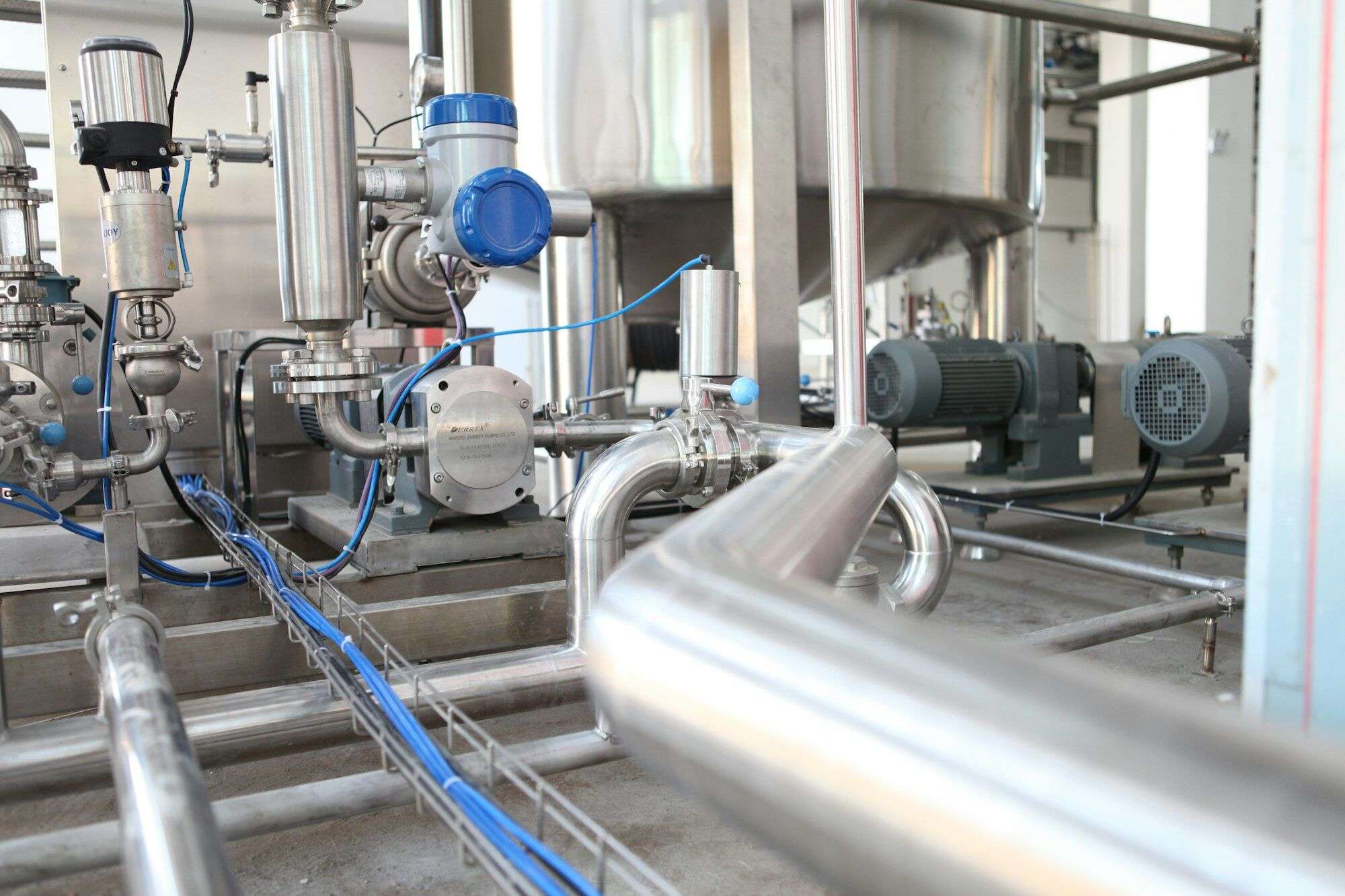
Pump VSD energy savings come from a simple mismatch: most process pumps in food and beverage plants are sized for the highest flow the plant might ever need, then run at full speed regardless of what the process actually requires. Flow is reduced with a throttling valve or returned through a bypass line, and the energy used to create that excess flow and pressure is lost. A variable speed drive (VSD) runs the motor at the speed the process needs instead.
How pumping energy is wasted
The pattern is common across water supply, cleaning, transfer and utility pumps:
- Throttled valves. A manual or control valve is partly closed to bring flow down to what the process needs, while the pump runs at full speed behind it.
- Bypass lines. Excess flow is recirculated back to a tank, and the pump moves product or water that does nothing useful.
- Pressure set for the worst case. Water supply pumps hold maximum pressure at all times, even when few outlets are open.
- Frequent stops and starts. Level-controlled transfer pumps cycle on and off, with high starting current and mechanical shock.
Why speed control saves energy
For centrifugal pumps, the affinity laws mean that power varies with the cube of speed. The Australian Government’s energy guidance notes that for pumps and fans, reducing motor speed by 20% can reduce the power required by 50%. A throttling valve reduces flow without reducing speed, so most of that potential saving is lost.
The saving is lower where the pump must overcome a large fixed static head, and lower again for positive displacement pumps, where power falls roughly in line with speed. Those differences are why each pump is assessed individually before projecting a return.
Where pump VSD energy savings come from
A VSD is fitted to each selected pump, and a control loop adjusts speed to hold the variable that matters to the process.
How it works
- 1
Choose the variable
Water supply pumps hold header pressure, CIP and transfer pumps hold flow, and tank pumps hold level.
- 2
Remove the waste
Throttling valves are opened fully or removed and bypasses closed, so the pump no longer works against them.
- 3
Control speed
The controller adjusts drive speed continuously to hold the setpoint as demand changes through the day.
- 4
Verify
Power is measured before and after, so the actual saving can be compared with the projection.
Quarries apply the same principle to pit and wash plant water, described in dewatering pump VSD control. Where pumps contribute to monthly peak demand, VSDs can also help reduce electricity demand charges.
What it is worth
Energy savings are the main benefit and the easiest to estimate. Soft starting, fewer pressure surges and gentler product handling are additional.
Alternatives
- Trim the impeller. A permanent, low-cost reduction for a pump that is consistently oversized. It cannot respond when demand changes.
- Replace with a smaller pump. Suitable for a steady duty, but most process demands vary.
- Pump packages with integrated drives. A good option at replacement time. Retrofitting drives to sound existing pumps achieves the saving without replacing the pump.
- Leave as is. No outlay, but the energy loss continues for every hour the pump runs.