
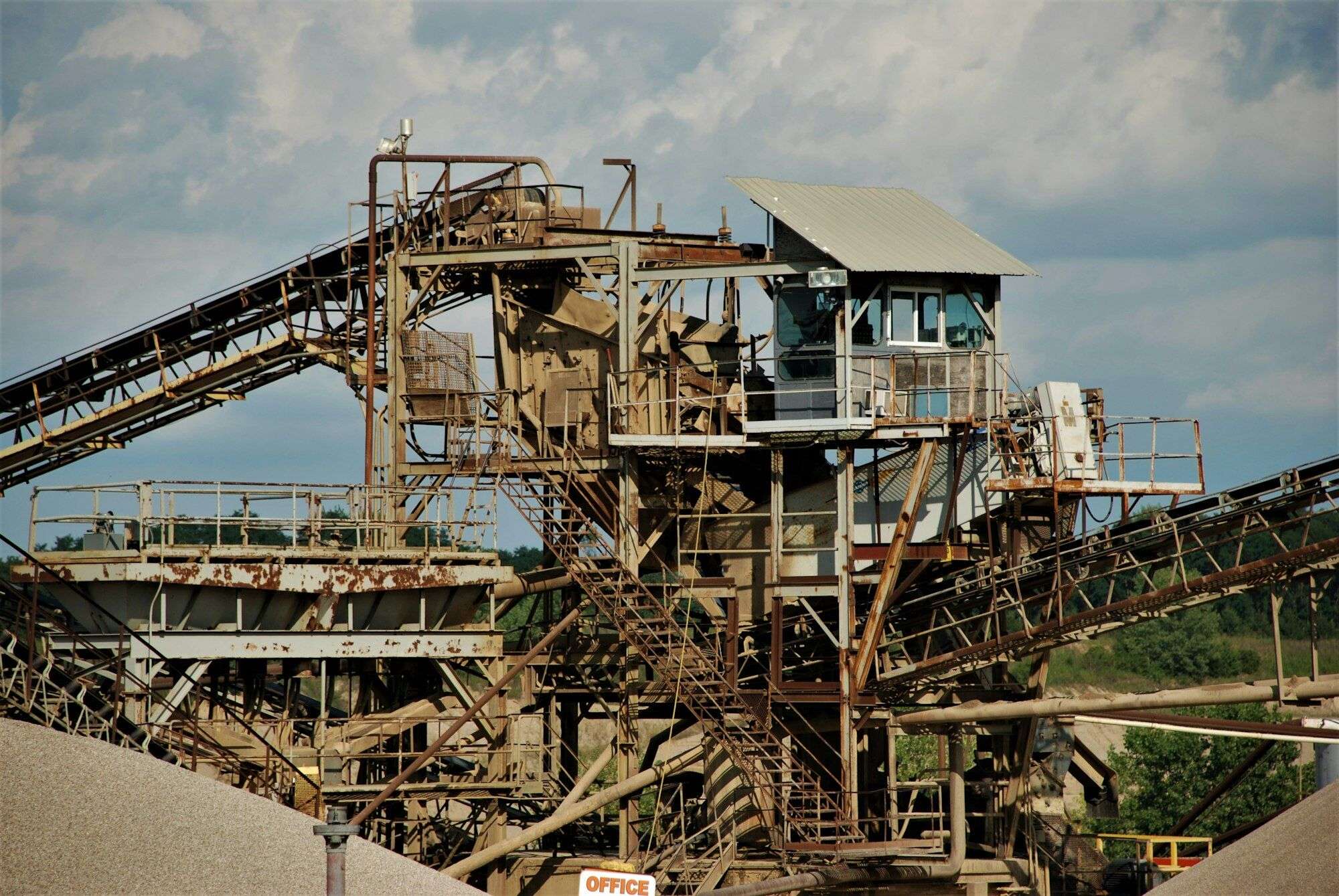
Cone crusher choke feeding means keeping the crushing chamber full of material at all times, so that rock is broken against other rock as well as against the liners. Cone crushers are designed to be operated this way. When the chamber is held full, the crusher delivers its rated capacity, a consistent product gradation and well-shaped, cubical aggregate. When the feed rate rises and falls, it does none of these reliably.
The cost of a crusher that is not choke-fed
Most circuits without automatic feed control show the same pattern. The feeder runs at a fixed speed, or at a speed an operator sets and adjusts by eye. As the surge bin level, feed size and moisture change through a shift, the cone alternates between running full, running partially empty and, at times, overflowing.
The consequences are operational and commercial:
- Lost throughput. A partially empty chamber processes less material per revolution. Every period the chamber is not full is capacity that has been paid for but not used.
- Inconsistent product. Without rock-on-rock crushing, the proportion of flaky and elongated particles increases and gradation varies through the day, which matters for products sold to a specification.
- Uneven liner wear. Starve-fed crushers concentrate wear in the lower part of the chamber. Liners are changed before the full wear profile has been used, and product quality degrades as the profile changes.
- Operator dependence. Keeping a crusher choke-fed by hand requires constant attention. Results vary between operators and between shifts.
Why feed rates vary
Crusher feed is variable by nature. Run-of-quarry or primary product arrives with changing size distribution, moisture and fines content, and the surge bin or stockpile ahead of the crusher rises and falls with upstream production. A fixed-speed feeder delivers a roughly constant volume regardless, so it cannot respond when the crusher’s demand changes.
An operator can compensate, but only intermittently. The chamber level is rarely visible from the control room, and the crusher’s response to a feed change is fast. The result is a cycle of overcorrection: feed is reduced after an overflow or a high-power alarm, the chamber empties, and feed is increased again.
Automatic choke feed control
The solution is a closed control loop that measures the level in the crushing chamber continuously and adjusts the feeder to hold that level at a setpoint. A variable speed drive (VSD) runs the feeder motor at whatever speed the crusher needs, rather than at a single fixed speed.
How it works
- 1
Measure
A radar level sensor mounted above the crusher feed opening measures chamber level continuously. Crusher power draw or hydraulic pressure is read from the existing controls where available.
- 2
Compare
A programmable logic controller (PLC) compares the measured level with the setpoint and calculates the feed rate required to hold it.
- 3
Adjust
The PLC sends a speed reference to the feeder VSD, increasing or reducing feed smoothly rather than starting and stopping the feeder.
- 4
Protect
If crusher load approaches its limit, feed is eased back before protection devices trip. Interlocks stop the feeder if the crusher or discharge conveyor stops.
Integration with existing plant
The system is added to the plant you already operate. In most circuits the scope is a level sensor, a VSD for the feeder, a PLC or an addition to an existing PLC, and an operator interface showing chamber level, feeder speed and crusher load. Existing crusher protection systems remain in place. Where a crusher already has manufacturer automation, the feed loop is integrated with it.
What cone crusher choke feeding is worth
Published case studies give an indication of the benefit. Aggregates Business reports that a Finnish quarry operator increased crusher throughput by 9% after introducing Metso Adaptive Feed Control, which slows the feeder as the cavity fills rather than stopping it. Results depend on how far a circuit currently is from choke-fed operation, which is assessed at the site visit.
The value of additional tonnes is rising in Queensland. A report prepared for the Queensland Department of Resources and Cement Concrete and Aggregates Australia forecasts quarry material demand rising 24% to a peak of 66.2 million tonnes in 2029 to 2030, from production of 53.4 million tonnes in 2021 to 2022, with South East Queensland accounting for 48% of production. For operations from Ipswich and the Scenic Rim to the Darling Downs and Central Queensland, more saleable tonnes from existing plant is a practical way to meet that demand.
Alternatives to automatic feed control
- Continue with manual control. No capital cost, but throughput, product consistency and liner life remain dependent on operator attention.
- In-house changes. Fitting a VSD and setting a fixed slower speed reduces overflows, but without level feedback it cannot respond to changing feed.
- A new or larger crusher. Appropriate where the circuit is genuinely at capacity. Where the existing crusher is not being choke-fed, the larger investment does not address the cause.
- Manufacturer automation. OEM crusher automation is a strong option and is typically designed around that manufacturer’s crushers. Where a site has mixed equipment or older crushers, an independent feed loop applies the same principle to the plant as it stands.
- A large systems integrator. Well suited to complete new plant. For a single circuit, the overheads of a large integrator are often disproportionate to the scope.