
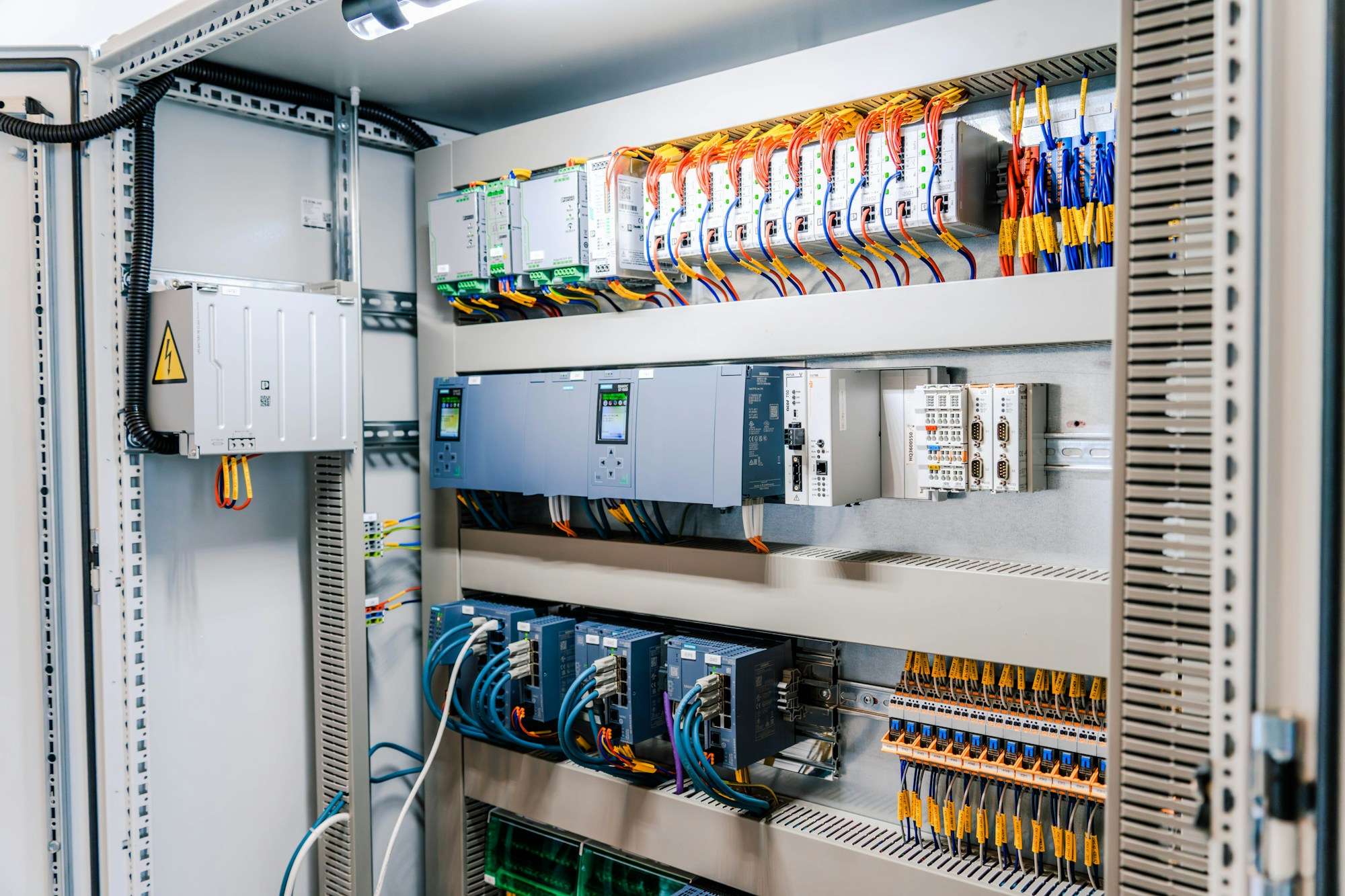
An S7-300 to S7-1500 migration moves an existing Siemens control system onto the current S7-1500 platform, carrying across the control logic, operator interfaces and network connections that the plant relies on. The S7-300 has been one of the most widely used programmable logic controller (PLC) families for more than two decades, and it is now at the end of its production life.
Where the S7-300 stands
Siemens has published the lifecycle of the S7-300 and the ET 200M distributed I/O family. According to Siemens, the product cancellation took effect on 1 October 2025, after which components are available only as spare parts, planned until 1 October 2033. New projects and plant expansions are no longer supplied on the platform.
For a site running an S7-300, this does not mean the system stops working. It means:
- Replacement CPUs and modules come from a shrinking pool of spare stock, at rising prices
- Expansions and modifications become harder to justify on an obsolete platform
- Engineers familiar with STEP 7 Classic become fewer each year
- A hardware failure after the spare parts period may have no straightforward fix
Why migrations are deferred, and why that is risky
The S7-300 is reliable, so the case for migration rarely feels urgent while it is running. Migration also has a reputation for being disruptive. The consequence is that many sites will be migrating under pressure: after a failure, with production stopped, and without time to test. ABB’s research found that unplanned downtime costs a typical Australian industrial business about $349,000 per hour. A planned migration replaces that exposure with a fixed-price project scheduled around production.
How an S7-300 to S7-1500 migration is carried out
The migration converts and tests the program before anything is changed on site.
The migration steps
- 1
Document
The S7-300 program, hardware configuration and network are backed up, and every input, output, interlock and sequence is documented.
- 2
Convert
The program is migrated to TIA Portal, with communication blocks, obsolete functions and third-party libraries reworked by hand.
- 3
Test
The converted program is tested off-site against the original behaviour, using simulated I/O for every sequence and fault.
- 4
Cut over
The S7-1500 is installed during a planned shutdown, with the S7-300 retained as a fallback until the new system is proven.
Typical decisions made at the site assessment include whether to retain the existing ET 200M I/O for a first stage, how PROFIBUS networks move to PROFINET, and how older HMIs are migrated. Sites running Allen-Bradley platforms face similar questions, covered in SLC 500 and PLC-5 migration.
The commercial case
A migration rarely pays for itself in energy or throughput. Its value is the removal of an outage risk, and a system that can be supported, modified and expanded again.
Alternatives
- Buy spares now. A reasonable short-term measure, but it does not address program support or the end of the spare parts period.
- Third-party refurbished modules. Useful in an emergency, but with uncertain history and no long-term path.
- Migrate to another platform. Possible, and sometimes right for the site. For most S7-300 users, the S7-1500 offers the most direct conversion path.
- A large systems integrator. Suited to large, multi-system programs. For a single PLC or a few, a scoped migration avoids those overheads.